
Notes - Basic Glossary and Concepts About REPE (Updating)
-
Absorption⭐
- Absorption is the amount of space or units occupied within a market over a given period of time, typically one year.
- Gross absorption = Total amount of space that tenants in a specific geographic area physically moved into during a specific period
- Net absorption = Total amount of space that tenants physically moved into – Total amount of space that tenants physically moved out
-
Gross Asset Value (GAV)
- The Gross Asset Value (GAV) is the sum of value of property a company owns.
- Besides the net asset value, the GAV is a common KPI for property funds to measure the success of the fund manager.
-
Net Asset Value (NAV)
- Net asset value (NAV) is the value of an entity's assets minus the value of its liabilities.
- NAV is one of the valuation indices of real estate investment trusts (REITs, pronounced "Reets").
-
Loan-to-value Ratio (LTV)⭐
- The loan-to-value (LTV) ratio is a financial term used by lenders to express the ratio of a loan to the value of an asset purchased. It is one of the key risk factors that lenders assess when qualifying borrowers for a mortgage.
- In Real estate, the term is commonly used by banks and building societies to represent the ratio of the first mortgage line as a percentage of the total appraised value of real property.
- The difference between loan value and asset value is called the "haircut" for the lender
- The higher the LTV ratio, the riskier the loan is for a lender.
-
Gross Building Area (GBA)
- Gross Building Area includes the total enclosed area of a building and the sum total of all floors.
- This is determined by the slab area measured to the exterior surface of the exterior walls, excluding elevator shaft openings.
- GBA is typically used as a measurement of office, industrial and agricultural buildings.
-
Gross Living Area (GLA)
- Gross Living Area is defined as the "Total area of finished, above-grade residential space"
- It is calculated by measuring the outside perimeter of the structure and includes only finished, habitable, above-grade living space.
-
Net Initial Yield (NIY)
- It is defined as the passing rent or net operating income divided by the gross property value including notional acquisition costs.
-
Yield on Cost (YOC)⭐
- Yield on cost is calculated as a property’s stabilized Net Operating Income (NOI) divided by the total project cost.
- It is a real estate financial metric that helps investors quantify the risk taken to purchase an asset. It is useful for two reasons
- It provides a way to compare the potential return on a value-add investment versus less risky alternatives.
- It is an easy, back-of-the-envelope way to calculate expected commercial real estate returns. As such, it can be a quick way to filter out deals that don’t meet our return criteria.
-
Capitalization Rate (Cap Rate)⭐
- Cap rate is generally calculated as the ratio between the annual rental income produced by a real estate asset to its current market value.
- It is used for the valuation of commercial properties.
- Entry cap rate, going-in cap rate, and terminal cap rate
- The entry cap rate is simply the cap rate at the time of purchase.
- The going-in cap rate is the projected first-year NOI divided by the initial investment or purchase price.
- The terminal capitalization rate is the projected NOI of the last year (exit year) divided by the sale price.
-
Average Daily Rate (ADR)
- The average daily rate (ADR) measures the average rental revenue earned for an occupied room per day.
- ADR = Rooms Revenue Earned / Number of Rooms Sold
- Multiplying the ADR by the occupancy rate equals the revenue per available room.
- The operating performance of a hotel or other lodging business can be determined by using the ADR.
-
The investment spread between cap rate and yield on cost⭐
-
As mentioned above, cap rate is defined as NOI / Current Mkt Value
-
While yield on cost is defined as NOI / Total Project Cost
-
Thus, when there is spread between cap rate and yield on cost (cap rate < YOC), it indicates that current mkt value is greater than initial project cost, reflecting the value added.
-
For example, the information below regarding the spread is used to analyze value-added investment
-
-
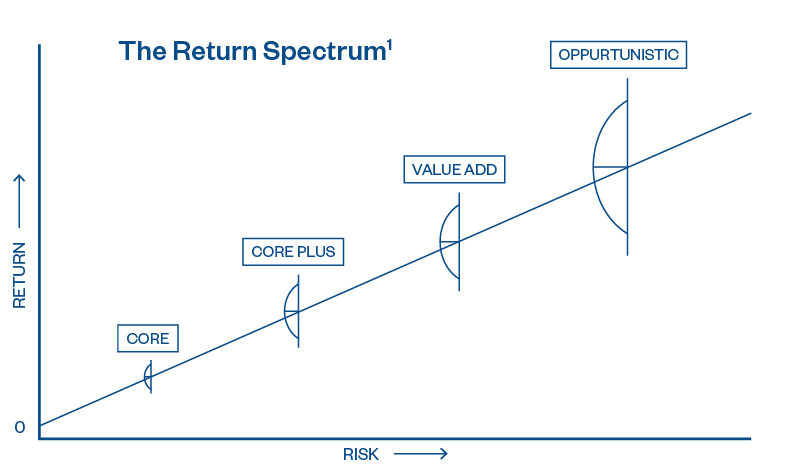
Strategies of Commercial Real Estate Investment⭐
-
Core
- Core real estate refers to stabilized property in a major metropolitan statistical area (MSA).
- "Stabilized" means "(almost) fully rented, with long-term leases, to tenants with good credit".
- It usually includes "Class A" buildings, and Class B without efforts to maintain.
- Core assets are considered "low-risk". They produce stable, predictable cashflow; they may not realize substantial appreciation, but there is minimal downside risk.
- Core investors may de-risk the investment even more by taking a “low-leverage” approach, financing the property with as little as 25% loan-to-value (LTV).
- It usually serves as a hedge against volatility and inflation.
-
Core Plus
- It is similar to core real estate, but with a little more risk factored in.
- The property may be older and more maintenance intensive. It may be in a suburb or secondary market. The tenants may be lower-credit and less reliable.
- The property may be financed at 50% LTV or higher.
- It entails more risk than "Core", but still relatively low to moderate.
- Core plus properties will take on losses in a down market before core real estate will.
-
Value-Add
-
Value-add real estate is operating below its potential, representing an opportunity to increase the property’s value.
-
Its risk profile is proportionally higher than the risk profile of core or core-plus opportunities.
-
Value-add opportunities may need significant repairs. They may be leased passively to maintain occupancy, or they may be filled with low-credit tenants. The tenants may be paying below-market rents.
- With targeted upgrades and improved management, the property may attract a better-quality tenant and command higher rental rates. Tenants may be willing to pay extra fees for added perks and amenities.
- There may be opportunities to reduce expenses as well — reducing utility and administrative costs, seeking property tax incentives or reassessments, or investing in technology to improve efficiency.
-
Increasing income and reducing costs increase the property’s net operating income (NOI), which has the dual effect of increasing cash flow and the property’s value.
-
Adding value to commercial property often requires significant cash upfront. Investors often leverage value-add real estate as much as 80% loan-to-value.
-
-
Opportunistic
- This strategy is similar to the value-add strategy, but the target property may be in even worse shape.
- It may be completely vacant. Core systems like plumbing or electricity may need to be overhauled or replaced to make the property habitable. It may be a tear-down or a new development property.
- Opportunistic property can be acquired for prices well below their core asset counterparts, but significantly more money and leverage are usually needed to complete the project.
- Timing plays the greatest role in an opportunistic strategy. It can take months or even years to execute the kind of rehab or repositioning needed for an opportunistic investment. The investor needs to consider today's market conditions and market conditions months or years from now.
-
Reference
- “How Is Net Absorption Calculated?” Jll.Com, 1 Nov. 2017, https://www.us.jll.com/en/trends-and-insights/cities/how-is-net-absorption-calculated.
- “Gross Asset Value.” Wikipedia, The Free Encyclopedia, 12 June 2022, https://en.wikipedia.org/w/index.php?title=Gross_asset_value&oldid=1092800413.
- “Net Asset Value.” Wikipedia, The Free Encyclopedia, 19 Apr. 2022, https://en.wikipedia.org/w/index.php?title=Net_asset_value&oldid=1083621393.
- “Loan-to-Value Ratio.” Wikipedia, The Free Encyclopedia, 1 May 2022, https://en.wikipedia.org/w/index.php?title=Loan-to-value_ratio&oldid=1085657523.
- “What Does GBA Mean in Commercial Real Estate?” Commercial Real Estate Blog in Dubai, UAE | CRC, Commercial Real Estate Consultants, 25 Oct. 2021, https://www.crcproperty.com/blog/what-does-gba-mean-in-commercial-real-estate/.
- “Net Initial Yield Definition.” Law Insider, https://www.lawinsider.com/dictionary/net-initial-yield.
- “What Is the Yield on Cost in Commercial Real Estate?” First National Realty Partners, 17 Mar. 2021, https://fnrpusa.com/blog/yield-on-cost/.
- “Capitalization Rate.” Wikipedia, The Free Encyclopedia, 4 Mar. 2022, https://en.wikipedia.org/w/index.php?title=Capitalization_rate&oldid=1075124475.
- Burton, Spencer. “Analyzing Value-Add Investments in Real Estate Using Yield-on-Cost.” Adventures in CRE, Adventures in CRE (A.CRE), 25 Aug. 2020, https://www.adventuresincre.com/value-add-yield-on-cost-real-estate-analysis/.
- “Balancing Risk and Return: Differences between Core, Value-Add, and Opportunistic Real Estate Investing Strategies.” Commercial Real Estate Investment Platform | Jamestown Invest, 4 June 2021, https://www.jamestowninvest.com/real-estate-360/balancing-risk-and-return/.