
How Is Oil Price Curve Driven by Ukraine Crisis?
Introduction
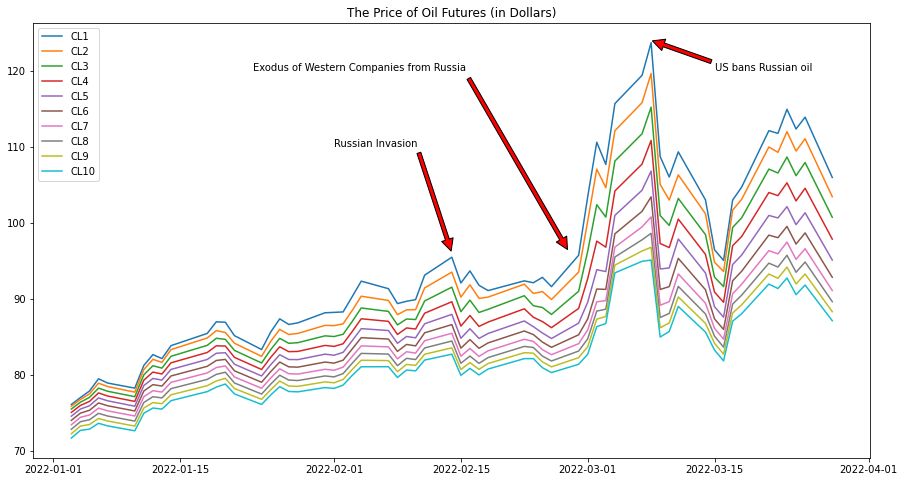
Russia invaded Ukraine on 24 February 2022. The invasion not only triggered Europe's largest refugee crisis since WWII, but also made crude oil prices soar to record highs in March then fluctuated violently, leaving this energy product with greater price uncertainty. Such uncertainty concerns some participants while encourages speculators. To have a better understanding in oil prices, this report focuses on temporary shocks, like this war, to market balances.
In this brief report, there are three main questions to be discussed, the first is the theoretical and real-life explanation of this price shock; the second is how oil spot price and futures price respond to the shock; last but not least, how market participants would act to this shock?
Theory and Reality
Russia accounts for about 10 percent of global petroleum production. Russian crude exports averaged 4.27 mb/d, with Europe accounting for around 60 per cent of Russia’s total crude exports, followed by Asia accounting for nearly 35 per cent (). As to Russia’s invasion of Ukraine in late February, early estimates suggested that perhaps 3 million barrels a day of petroleum production—almost 3 percent of world production—had been effectively removed from the global oil market, constituting one of the largest supply shortfalls since the 1970s. (Kilian and Michael, 2022)
However, the demand side of oil has become even stronger since the beginning of 2022. The International Energy Agency forecasted that global oil demand will exceed pre-pandemic levels this year as recent virus waves haven’t proved severe enough to warrant a return to strict lockdown measures (Will, 2022). With booming demand and disruption in supply, both the spot price and futures price have become much more volatile.
The relationship between commodity spot and futures prices can in part reflect the perception of short-term physical scarcity (Shaun and Neşe, 2010). The slope of the futures curve, measured as the difference between the price of a futures contract at some given maturity and the spot price, can provide information on whether market participants anticipate relative abundance or scarcity in the physical market. Below the figure shows how the slope of oil futures changed as crisis escalated. 'CL1' stands for Generic 1st 'CL' Future.
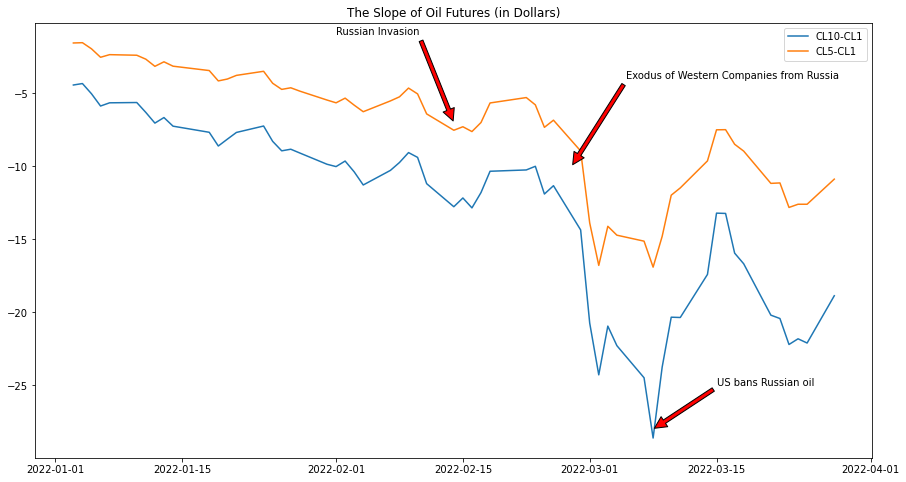
Generally, the slope can change for one of three reasons:
- A change in interest rates
- A change in physical storage costs
- A change in the market’s perception of short-term scarcity and a compensating adjustment in the utility afforded by holding inventories.
Theoretically, large changes in the futures curve slope are rarely caused by the first two explanations. Even though both interest rates and storage costs can move significantly over time, the very large discrete changes required to steepen or flatten futures curves sharply and rapidly are unlikely. In addition, it is highly impossible for a demand disruption to exist since the this shock looks low persistent and less smooth (Martin, 2017; Jone and Alain, 2020). This is especially true under current circumstances, where the crude oil from Russia is under boycott, thus causing expected supply disruptions.
Related to the real world, there are both long-term and short-term dynamics playing here.
-
In the long-run oil supplies have dwindled as economies have bounced back from Covid-19, and supply growth has not kept up; and there’s a lot of competition for barrels of oil coming to market, because refiners want to cash in on rising demand.
-
The shorter-term issue is Russia’s invasion of Ukraine. Uncertainty about sanctions and whether Russia will withhold oil exports from Europe has frightened traders and added a premium to prices. In addition, refineries are competing to secure alternatives to Russian crude out of fear of sanctions, causing Brent prices to soar in the near-term.
Reponses from Spot and Futures
The shape of oil futures curve has been evolving from contango to backwardation twice in the past 3 years. Before COVID-19 started raging, oil futures curve turned from contango to backwardation because previous surplus in oil inventories was gradually digested. In the following 2020 when COVID suppressed the oil demand from production activities, the curve then reversed to contango again. Finally the most recent backwardation came as post-COVID era released great demand for the recovery of economy. How do the price of spot and futures with different maturities respond to new changes? And how they differ themselves from the others?
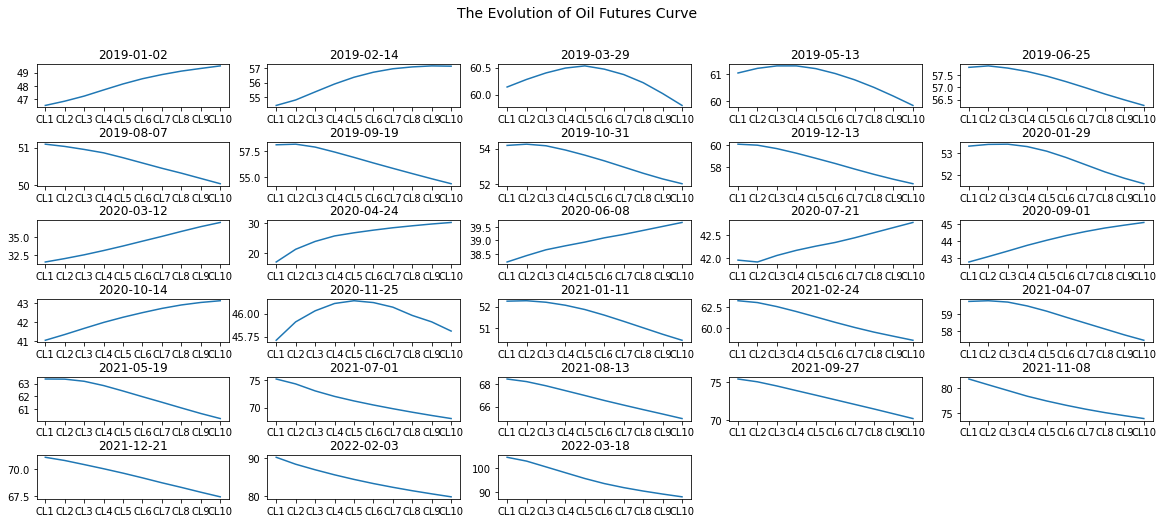
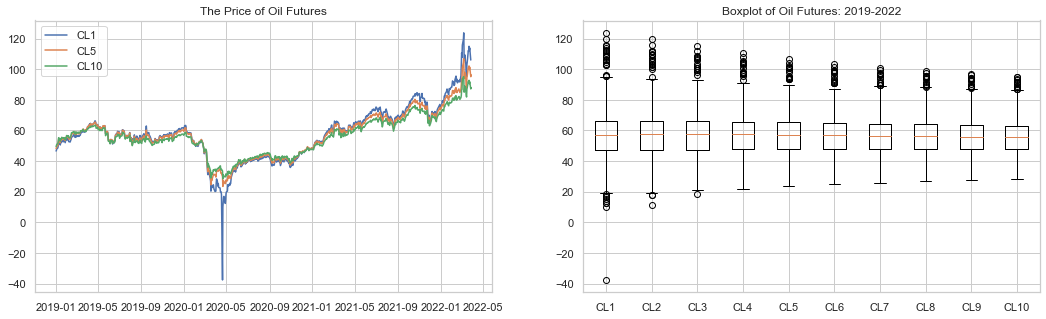
The most recent backwardation is getting strengthened by Russian invasion. With the escalation of Ukraine Crisis, the spot price (CL1) of crude oil drastically surged, leaving higher volatility. Compared with spot, longer-dated futures (CL2-CL10) are trading much lower because traders don’t expect these panicked dynamics to last. They believe that either the oil export sanction on Russia will end, or the market will find a way around the issue (Avi, 2022).
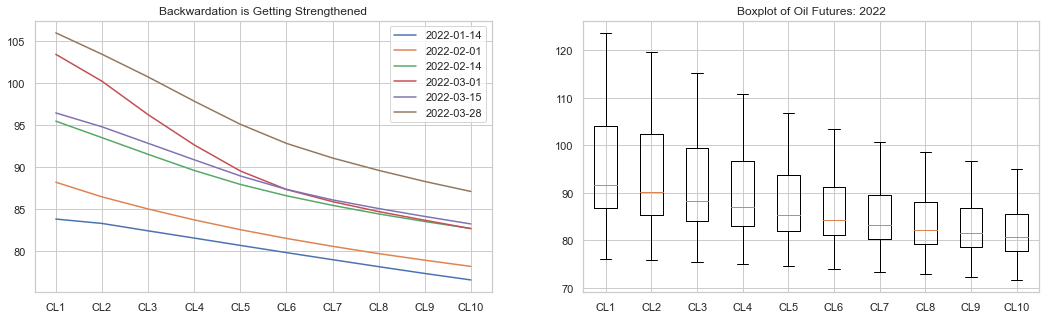
And this phenomenon also applies with data of recent 3 years. Noticeably there is one negative value lying on the spot curve, at which traders who couldn’t take on and store any more product but nobody wanted to buy as demand dried up (Walker, 2020). In contrast, futures did not move that drastically with lower standard deviation.
Plus, oil futures market offers deeper liquidity than spot. A liquid market is generally associated with less risk because there is always someone willing to take the other side of a given position, and traders will incur less slippage. Its robust liquidity supports the process of price discovery and allows traders to transact in the market swiftly and efficiently. Eventually it will make prices to converge at expected level.
And liquidity indicates higher trading volume, which is inversely proportional to volatility. This is because liquidity provision is a bet against private information: if private information regarding crude oil turns out to be higher than expected, liquidity providers lose. Since information generates volatility, and volatility co-moves across assets, liquidity providers have a negative exposure to aggregate volatility shocks. (Itamar, Alan, and Alexi, 2020).
Responses from Market Counterparties
As Russian crude oil has been indirectly sanctioned since financial institutions started to refuse financing Russia-related transactions, it is becoming more and more struggling for western traders to clear Russian cargoes—this has been reflected in widening oil price differentials and rising shipping and insurance costs, which are due to war premium.
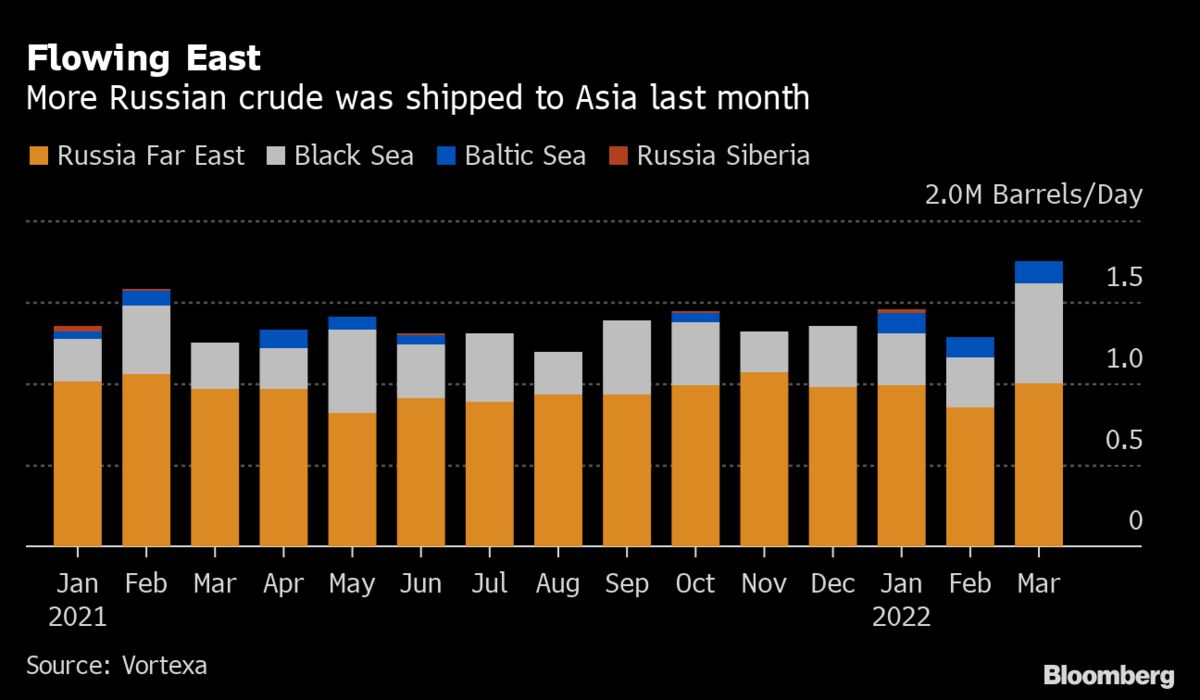
Massive shifts in trade flows and sharp adjustments in price differentials (which is due to inefficient arbitrage in oil market across regions) to reflect shifts in Russian crude exports. Particularly, there could be a greater redirection of flows from Europe to Asia with private buyers from China, Japan and India. And this has already happened last month, when more Russian crude was shipped to Asia.
At the sell side, Russian oil companies could offer sweeteners to buyers to make their barrels more attractive, for instance shifting cargoes from FOB (Free on Board) to CFR (Cost and Freight) basis.
Summary
This historically severest oil futures backwardation is, theoretically, due to a sudden disruption in supply, which is in reality in line with the fear for sanctions on Russia's oil export and incentivizes refiners to compete for alternatives. These two factors have pushed the spot price to a very high level. Meanwhile, as the market participants (traders) expect that in the long run the oil export sanction on Russia will end or the market will find substitutes, futures prices did not respond as fiercely as the spot price did. In addition to the expectation from traders, as oil futures offers abundant counterparty and is more accessible, it thus allowing higher trading volumes, which enables better price discovery and converge, thus lower volatility. While some western traders are struggling at clearing Russia cargoes on hand, Russian oil producers are offering not only low price but also favorable terms such as CFR to attract East Asia buyers, and this has been proven to be successful.
References
-
Kilian, Lutz, and Michael D. Plante. “The Russian Oil Supply Shock of 2022.” Dallasfed.org, Federal Reserve Bank of Dalas, 22 Mar. 2022, https://www.dallasfed.org/research/economics/2022/0322.
-
Horner, Will. “Oil Demand to Exceed Pre-Covid Levels in 2022, IEA Says.” The Wall Street Journal, Dow Jones & Company, 19 Jan. 2022, https://www.wsj.com/articles/oil-demand-to-exceed-pre-covid-levels-in-2022-iea-says-11642582801.
-
Roache, Mr Shaun K., and Ms Nese Erbil. "How commodity price curves and inventories react to a short-run scarcity shock". International Monetary Fund, 2010.
-
Stuermer, Martin. "Demand Shocks Fuel Commodity Price Booms and Busts." Economic Letter 12.14 (2017): 1-4.
-
Baffes, Jone, and Alain Kabudi. “Persistence of Commodity Shocks.” World Bank Blogs, World Bank, 12 Nov. 2020, https://blogs.worldbank.org/developmenttalk/persistence-commodity-shocks.
-
Salzman, Avi. "Severe Oil Backwardation Is Here. It's Not All Bad for Stocks." Barron's, 25 Feb. 2022, https://www.barrons.com/articles/severe-oil-backwardation-is-here-its-not-all-bad-for-stocks-51645804011.
-
Walker, Andrew. “US Oil Prices Turn Negative as Demand Dries Up.” BBC News, 21 Apr. 2020, www.bbc.com/news/business-52350082.
-
Drechsler, Itamar, Alan Moreira, and Alexi Savov. Liquidity and volatility. No. w27959. National Bureau of Economic Research, 2020.