
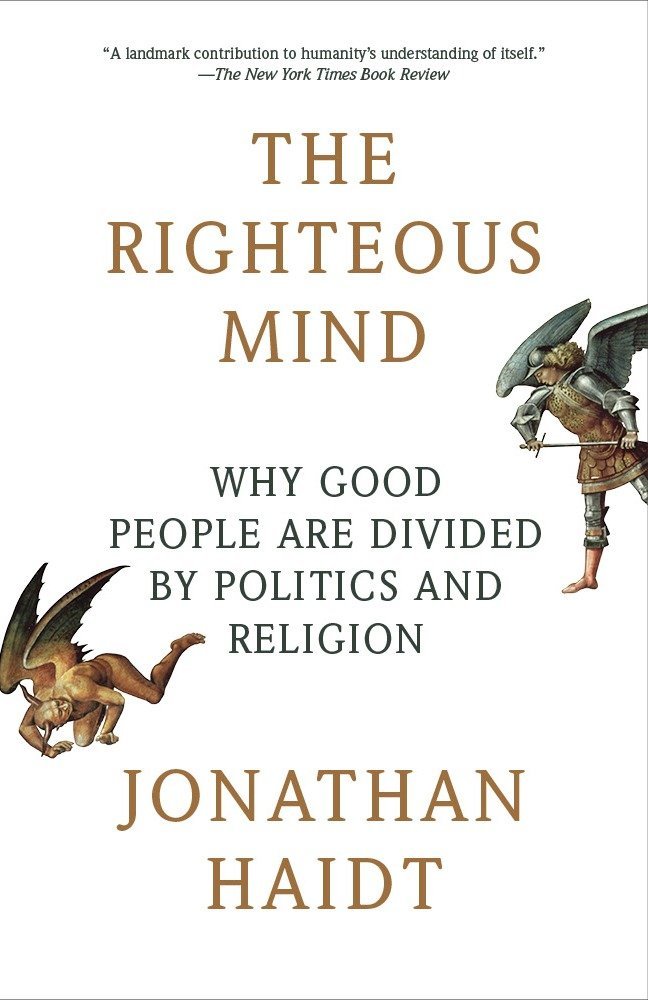
Book Review - The Righteous Mind: Why Good People Are Divided by Politics and Religion
Preface
It has been a while since last time I updated my personal blog, making me question whether I should continue writing casually. I wondered about my purpose, the necessity of it, and whether I had the time to maintain a regular frequency. However, I quickly realised that these doubts were not obstacles for me because I genuinely enjoy expressing myself through words. Here I present this short book review as a new start.
Stop Presenting Yourself as a Rationalist
"Conscious reasoning functions like a press secretary who automatically justifies any position taken by the president."
To support this principle, the author and their colleagues conducted several experiments. For example, they presented volunteers with hypothetical situations and asked them to determine if those situations were morally acceptable or not. In most cases, the volunteers provided instant judgments but struggled to provide a well-justified reason for their decision; or they sometimes found supporting evidence long after making initial judgment.
Honestly speaking, I am not surprised by these findings as I have always been skeptical of so-called "reasoning-driven conclusion"; and this chapter reminds me of my internship at a management consulting company. Prior to joining the team, I believed the job mainly involved solving business problems using logic and commercial sense, with the aim of providing unbiased advice to clients. However, once I began my work, I gradually realised that consultants often find themselves tirelessly justifying their clients’ perspectives with fancy reasonings. That's also a vivid reflection of "the elephant and the rider" in real life.
While it is true that human beings have the ability to use reason and logic to achieve success (as great scientists have done), not everyone is good at reflecting on their inner “elephant’s” immediate decisions and inviting the rational “rider” to intervene. This is particularly evident in the financial industry, for instance. Whenever I click on and scroll through a research paper on a specific company or industry, it becomes challenging to disregard the subjective tone of the text and focus solely on the facts. As an ordinary reader, I often find myself forming opinions in agreement or disagreement with the strategists’ views based on that embedded tone alone.
Reasoning can take us to almost any conclusion we want to reach. Then is it critical to reason flawlessly for arguments to which we adhere? I would say sharp intuition matters more, and keeping practicing on logical reasoning may coincidentally be the way to develop such a strong intuition.
Wining Support by Appealing to Shared Moral Foundations
“There’s more to morality than harm and fairness”
People often form instant judgments about an initiative or plan based on their inner moral foundations. It is important to understand that these foundations can vary between individuals and different political perspectives. While liberals tend to prioritise fairness and minimising harm, conservatives also place some weight on loyalty, authority, and sanctity in addition to fairness and harm considerations.
While it may be challenging to shake someone’s moral foundations, it is possible to engage in a process of sniffing out and recognising different perspectives. Next time when entering into negotiations with counterparties, it can be beneficial to consider their backgrounds and make an educated guess about their moral foundations. Understanding their underlying values and beliefs can help inform how you approach the negotiation process. In many cases, appealing to a person’s moral instincts can be more persuasive than relying solely on logical reasoning.
Take an extreme example: in Vietnam (from another parallel universe), propaganda machines are adept at manipulating individuals by appealing to their inner moralities, and the authority relies little on convincing citizens by letting them engage in open panels and engage in debates---which are totally unnecessary formalism to reach planned goals. Likewise, there is a Chinese proverb saying "动之以情,晓之以理" (Move others’ hearts with emotions, make others understand with reasoning). Most of people are inclined to act based on weak reasonings but strong emotions. If we are able to appeal to their moral values and strike the right emotional chords, we have a higher chance of gaining their preference.
“We are deeply intuitive creatures whose gut feelings drive our strategic reasoning. This makes it difficult—but not impossible—to connect with those who live in other matrices, which are often built on different configurations of the available moral foundations.”
Reference
Haidt, J. (2012). The righteous mind: Why good people are divided by politics and religion. Vintage.